

What complex, bioactive marine lipids enable
When we talk about marine oils, the conversation often starts – and ends – with individual fatty acids. EPA. DHA. Sometimes a third molecule is added for context.
But biology does not work in isolation.
Zooca Calanus Oil is a natural, bioactive marine lipid ingredient where function emerges from the interaction between multiple components, delivered within a distinct lipid structure. To understand what these bioactive marine lipids enable biologically, we need to look beyond single nutrients and toward systems.
A marine lipid shaped by biology
Zooca Calanus Oil is derived from Calanus finmarchicus, a zooplankton species naturally rich in bioactive lipids and nutrients. Unlike conventional marine oils, its lipid fraction is dominated by wax esters, with fatty acids bound to long‑chain fatty alcohols rather than glycerol.
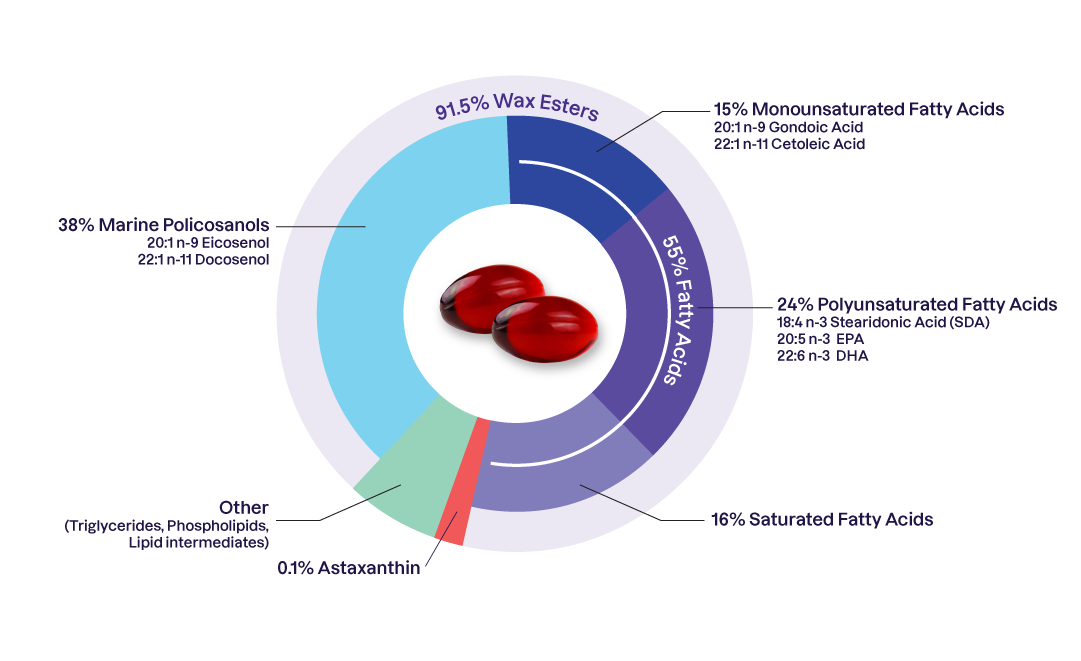
Within this matrix, the oil naturally contains:
- A broad spectrum of fatty acids (including EPA, DHA, SDA, MUFAs and others)
- Marine policosanols
- Naturally occurring astaxanthin
Each of these components has been studied individually. More importantly, they occur together in nature, and remain together through gentle, solvent‑free processing. This is why we say our unique Zooca Calanus Oil goes beyond omega-3.
Together, these naturally occurring bioactive marine lipids create a unique biological system rather than isolated nutrients.
👉 Learn more about the key components of Zooca Calanus Oil:
Why lipid structure matters for function
Lipid structure plays a decisive role in digestion and absorption. Wax esters follow a slower and more distal digestion pattern than triglycerides, influencing where and how fatty acids become available in the intestine.
This has functional consequences.
Research has shown that slower lipid digestion may allow fatty acids to reach regions of the gut where receptors involved in metabolic regulation are expressed, including G‑protein‑coupled receptors such as GPR120 (FFA4), which are linked to insulin sensitivity and metabolic signaling.
This provides a mechanistic framework for understanding why lipid structure – not just lipid content – matters.

Metabolic health and glucose regulation
Metabolic health is increasingly recognized as a foundation for long‑term health, performance, and healthy ageing. In adults with overweight and impaired glucose regulation, supplementation with Zooca Calanus oil has been shown to improve insulin sensitivity and glucose homeostasis.
In a randomized controlled trial, Zooca Calanus Oil combined with lifestyle intervention led to significant improvements in insulin resistance measured by gold‑standard methods.
These effects cannot be fully explained by EPA and DHA alone but are consistent with a structure‑driven metabolic response, where digestion kinetics and lipid signaling pathways play a role.

Cardiometabolic and heart health
Metabolic regulation and cardiovascular function are closely interconnected systems. In human studies, Zooca Calanus oil supplementation has been associated with improvements in cardiac function parameters, particularly in individuals with metabolic dysfunction.
A pilot study in obese and prediabetic women showed improved cardiac diastolic function following Calanus oil supplementation.
These findings support the view that cardiometabolic health is not a collection of isolated endpoints, but a coordinated system response influenced by lipid metabolism, insulin sensitivity, and tissue function.
Body composition and physical performance
Beyond metabolic markers, Zooca Calanus oil has demonstrated effects on body composition and muscle function.
Human intervention studies show reductions in fat mass alongside increases in lean body mass and muscle strength. These outcomes are relevant across life stages, from performance‑oriented nutrition to maintaining functional capacity with age.
Importantly, these effects are observed without stimulation or acute activation, but through gradual metabolic adaptation.
Healthy ageing: strong from the inside out
Healthy ageing is not defined by a single biomarker. It reflects the ability to maintain metabolic flexibility, muscle function, and cardiovascular performance over time.
By influencing these interconnected systems simultaneously, Zooca Calanus Oil supports healthy ageing from the inside out, through metabolic health as a biological foundation, rather than symptom‑specific targeting. The reported effects are observed at nutritionally relevant doses in controlled human intervention studies
From components to function
Each component in Zooca Calanus Oil matters. But it is their combination, structure, and biological context that enables function.
This is what complex bioactive marine lipids can do – when nature is allowed to set the design.
References
- Hirasawa A. et al. Nature Medicine (2005). Free fatty acids regulate gut hormone secretion through GPR120. DOI: 10.1038/nm1293
- Kerlikowsky, F. et al (2025) Calanus Oil and Lifestyle Interventions Improve Glucose Homeostasis in Obese Subjects with Insulin Resistance. Marine Drugs, 23, 139. | https://www.mdpi.com/1660-3397/23/4/139
- Kerlikowsky, F et al (2025). Effects of 12 Weeks of Calanus Oil Supplementation on Cardiac Diastolic Function in Obese and Prediabetic Women — A Pilot Study. Metabolites, 15(9), 596.| https://www.mdpi.com/2218-1989/15/9/596
- Stepan, M., et al (2022) ) Exercise Training Combined with Calanus Oil Supplementation Improves the Central Cardiodynamic Function in Older. Nutrients . Nutrients, 14,149. | https://www.ncbi.nlm.nih.gov/pmc/articles/PMC8747381/