

Beyond Omega-3: Fatty Acid Diversity in Zooca Calanus Oil
The importance of fatty acid diversity
When marine oils are compared, attention is often narrowed to a specific few fatty acids, most notably EPA and DHA. While these long chain omega-3 fatty acids are well documented and critically important, they represent only a subset of the fatty acids naturally present in all marine organisms – which is a large part of what makes eating seafood healthy.

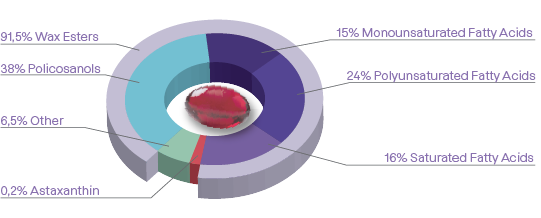
Zooca® Calanus® Oil, a marine lipid derived from Calanus finmarchicus, is characterized by a naturally occurring fatty acid profile that contains more than 40 different fatty acids. This diversity reflects the actual lipid composition of Calanus finmarchicus and distinguishes the oil from other refined or concentrated marine oil products, where the fatty acid profile is typically isolated or simplified (Pedersen et al., 2014).
Fatty acid diversity in natural marine oils
The fatty acid composition of Zooca Calanus Oil contains a unique composition of saturated, monounsaturated, and polyunsaturated fatty acids, spanning a range of healthy fats in the omega-3, omega-6 and omega-9 families.
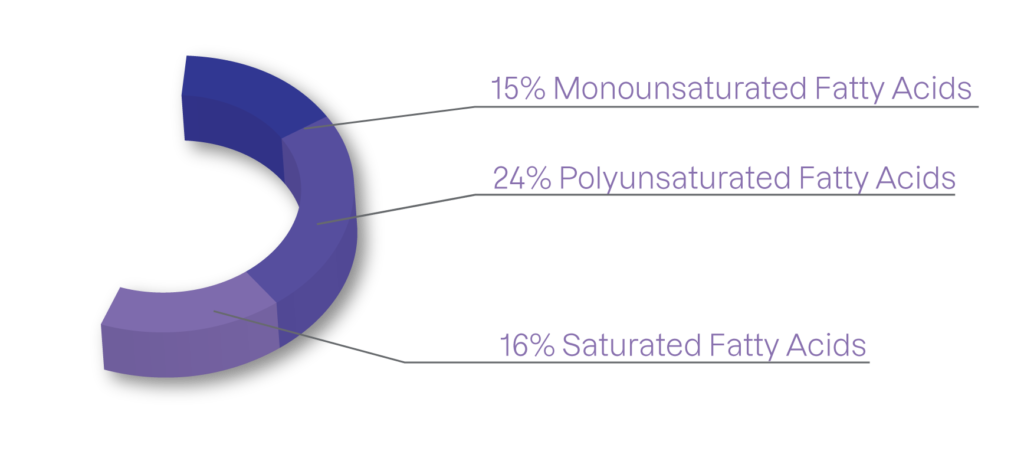
This broad distribution reflects the biological role of lipids in marine food webs and contrasts with oils that have been processed and refined to enrich a small number of specific fatty acids (Pedersen et al., 2014; Cook et al., 2016). Rather than being dominated by a few specific fatty acids, Zooca Calanus Oil retains a broad- spectrum of fatty acids, with a wide range of fatty acids present as they are in naturally occurring proportions. This naturally broad profile is preserved because Zooca Calanus Oil is minimally processed and gently extracted, allowing the natural fatty acid composition of Calanus finmarchicus to remain intact. Just as nature intended.
Comparing Marine Lipids — How Zooca® Calanus Oil Stands Out
Each marine lipid has distinct properties, but Zooca Calanus Oil is unique due to its complex composition and natural extraction process. Unlike other marine oils, Zooca Calanus Oil is unrefined, preserving its natural structure and bioactive compounds — just as nature intended.
| Marine Lipid | Source | Key Components and form | Health Benefits | Production Process |
|---|---|---|---|---|
| Zooca® Calanus Oil | Calanus finmarchicus, a zooplankton harvested in the Norwegian Sea | Wax Ester. Marine policosanols, more than 40 different fatty acids, including omega-3, 7, 11 and astaxanthin | Delivers traditional Omega-3 benefits in addition to supporting enhanced insulin sensitivity and overall metabolic health | Minimally processed and unrefined |
| Krill Oil | Euphausia superba, Antarctic krill, harvested in Antarctic ocean | Phospholipids, Omega-3s, choline, astaxanthin | Supports brain and heart health, cognitive function and inflammation management | Often processed and refined |
| Fish Oil | Most common: Anchovies, mackerel, sardines from Southeast Pacific, North Atlantic, and Southwest Atlantic | Triglycerides. Omega-3s (EPA/DHA) | Supports heart and brain health, reduces triglycerides, and improves joint function | Often processed and refined |
| Algae Oil | Microalgae most commonly used in Omega 3 production, Schizochytrium sp. | Triglycerides. Omega-3s (DHA/EPA) | Supports heart, brain and eye health, particularly for vegetarians and vegans | Often processed and refined |
Table 1. Marine lipids, source, key components and form, health benefits and production process
Beyond EPA and DHA
Although EPA and DHA are important components of Zooca Calanus Oil, this does not fully describe the unique fatty acid profile. A defining characteristic of the oil is the presence of many fatty acids that are typically present at low levels, or absent entirely, in most refined commercially available marine oils.
This includes long-chain monounsaturated fatty acids, which are a natural part of marine lipid profiles. These fatty acids have been well described in scientific literature demonstrating a benefit with intake in regard to lipid metabolism and cardiovascular markers, primarily in observational and interventional context (Yang et al., 2013; Yang et al., 2016; Yang et al., 2020).
Together, the unique diversity of fatty acids contributes to the overall benefits of Zooca Calanus oil and reinforces that its composition cannot be adequately summarized by the omega 3s EPA and DHA alone.
Stearidonic acid (SDA) as part of the fatty acid spectrum
Among the omega 3 fatty acids present in Zooca Calanus Oil, besides EPA and DHA, is stearidonic acid, SDA (18:4 n-3). SDA occupies a metabolic position between 18 Carbon alpha-linolenic acid (ALA), as it converts to the longer chain EPA, which is 20 Carbons.

Unlike ALA, SDA bypasses the initial delta-6 desaturase enzyme step in the omega-3 conversion pathway, which has been described as a rate-limiting step in the endogenous synthesis of longer-chain omega-3 fatty acids. As a result of being more readily converted, SDA has been shown to contribute to an increase in EPA status more efficiently than ALA, even when present in lower absolute amounts (Ruxton et al., 2005; DeFilippis & Sperling, 2006).
Experimental studies have further examined the metabolic conversion of SDA in cellular models, supporting its role as an intermediate omega-3 fatty acid rather than an end product (Li et al., 2017).
In Zooca Calanus Oil, SDA occurs naturally as part of the overall fatty acid composition and contributes to the diversity of omega 3 fatty acids present in the oil. Together with EPA and DHA, SDA contributes to an overall increase in blood omega 3 levels observed in clinical studies, with an average improvement of 20%.
Fatty acid diversity as a defining characteristic
The presence of more than 40 different fatty acids highlights that Zooca Calanus Oil cannot be adequately described using a single-fatty-acid perspective.
Instead, fatty acid diversity is regarded as a defining characteristic of the oil, and is closely linked to:
- its biological origin
- its natural, unrefined composition
- the broad distribution of fatty acids present
Considering fatty acid diversity alongside individual fatty acids provides a more complete description of the oil. It also supports a broader understanding of marine lipids beyond focusing on individual fatty acids alone, and rather exploring the unique benefits when the oils work in synergy with how they exist in nature
In this context, Zooca Calanus Oil can be positioned as a uniquely differentiated marine lipid ingredient.
This broader view of fatty acid composition provides a relevant framework for considering how marine lipid ingredients may be applied in metabolic health–focused products.
References
Pedersen, A. M., Vang, B., & Olsen, R. L. (2014).
Oil from Calanus finmarchicus—Composition and possible use: A review.
Journal of Aquatic Food Product Technology, 23(6), 633–646.
https://doi.org/10.1080/10498850.2012.741662
Cook, C. M., Larsen, T. S., Derrig, L. D., Kelly, K. M., & Tande, K. S. (2016).
Wax ester rich oil from the marine crustacean Calanus finmarchicus is a bioavailable source of EPA and DHA for human consumption.
Lipids, 51, 1137–1144.
https://doi.org/10.1007/s11745-016-4189-y
Yang, Z. H., Miyahara, H., Iwasaki, Y., & Katayama, M. (2013).
Dietary supplementation with long-chain monounsaturated fatty acids attenuates obesity-related metabolic dysfunction and increases expression of PPARγ in adipose tissue in type 2 diabetic KK-Ay mice.
Nutrition & Metabolism, 10, 16.
https://doi.org/10.1186/1743-7075-10-16
Yang, Z. H., Emma-Okon, B., & Remaley, A. T. (2016).
Dietary marine-derived long-chain monounsaturated fatty acids and cardiovascular disease risk: A mini review.
Lipids in Health and Disease, 15, 201.
https://link.springer.com/article/10.1186/s12944-016-0366-5
Yang, Z. H., Amar, M., Sorokin, A. V., et al. (2020).
Supplementation with saury oil, a fish oil high in omega-11 monounsaturated fatty acids, improves plasma lipids in healthy subjects.
Journal of Clinical Lipidology, 14(1), 53–65.e2.
https://www.lipidjournal.com/article/S1933-2874(19)30320-4/abstract
Li, Y., Rong, Y., Bao, L., et al. (2017).
Suppression of adipocyte differentiation and lipid accumulation by stearidonic acid (SDA) in 3T3-L1 cells.
Lipids in Health and Disease, 16, 181.
https://doi.org/10.1186/s12944-017-0574-7
Ruxton, C. H., Calder, P. C., Reed, S. C., & Simpson, M. J. (2005).
The impact of long-chain n-3 polyunsaturated fatty acids on human health.
Nutrition Research Reviews, 18(1), 113–129.
https://pubmed.ncbi.nlm.nih.gov/19079899/
DeFilippis, A. P., & Sperling, L. S. (2006).
Understanding omega-3’s.
American Heart Journal, 151(3), 564–570.
https://doi.org/10.1016/j.ahj.2005.03.051