
Marine Policosanols – The Unique Bioactive
A marine oil built differently
Zooca® Calanus® Oil is a wax ester–based marine oil. The wax ester structure brings with it a substantial and often overlooked component called Marine Policosanols. These long-chain alcohols are not added or enriched. They are an intrinsic part of the oil’s molecular design and a key differentiator to other marine oils.
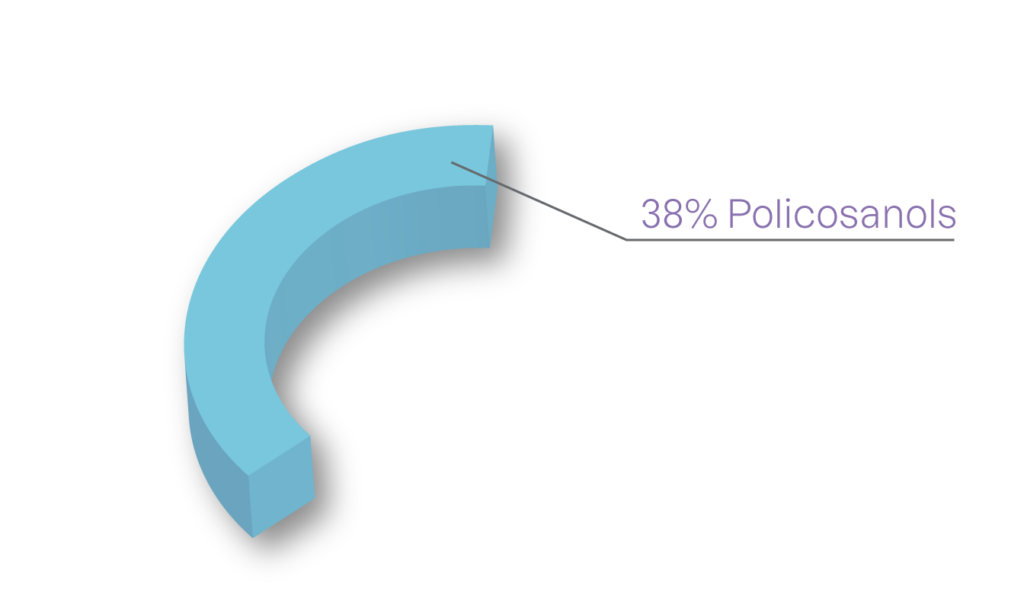
Unlike triglyceride-based oils, where three fatty acids are attached to glycerol, wax esters consist of a fatty acid naturally esterified to a long-chain alcohol. Because Calanus finmarchicus stores energy as wax esters, Zooca® Calanus® Oil therefore naturally contains a large, long-chain alcohol fraction alongside its fatty acids. Approximately 40% of Zooca® Calanus® Oil consists of marine policosanols, the long-chain alcohol component of the wax ester structure.
Most marine oil comparisons focus only on EPA and DHA. In a wax ester–based oil, these fatty acids are only a part of the lipid system. Marine policosanols are not an optional feature, as they are a natural structural consequence of the native wax ester design.
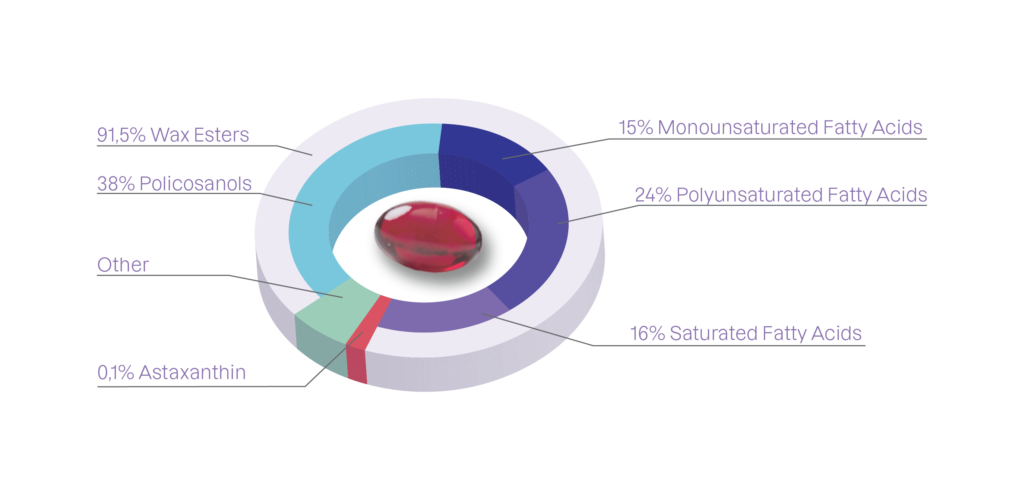
Nothing added. Nothing enriched. Nothing removed.
What are policosanols?
Policosanols are naturally found in various fruits, plants, and whole seeds. They are substances that humans have naturally consumed through the diet. They are known for constituting part of the waxy layer we often see on the outside of seeds and fruit. However, most modern food processing methods remove the wax from the food, leading to a reduction in policosanol intake.
The marine policosanols found in Zooca® Calanus® Oil are bioactive molecules that resemble long-chain monounsaturated fatty acids and form an integral part of the wax esters in the oil. In scientific terminology, these molecules may be described as long-chain fatty alcohols. In nutritional literature, they are often referred to as policosanols. The terminology differs, but the chemical class is the same. Chemically, the marine policosanols in Zooca® Calanus® Oil are long-chain fatty alcohols in the C20–C22 range. The dominant fatty alcohols include:
- Eicosenol (C20:1)
- Docosenol (C22:1)
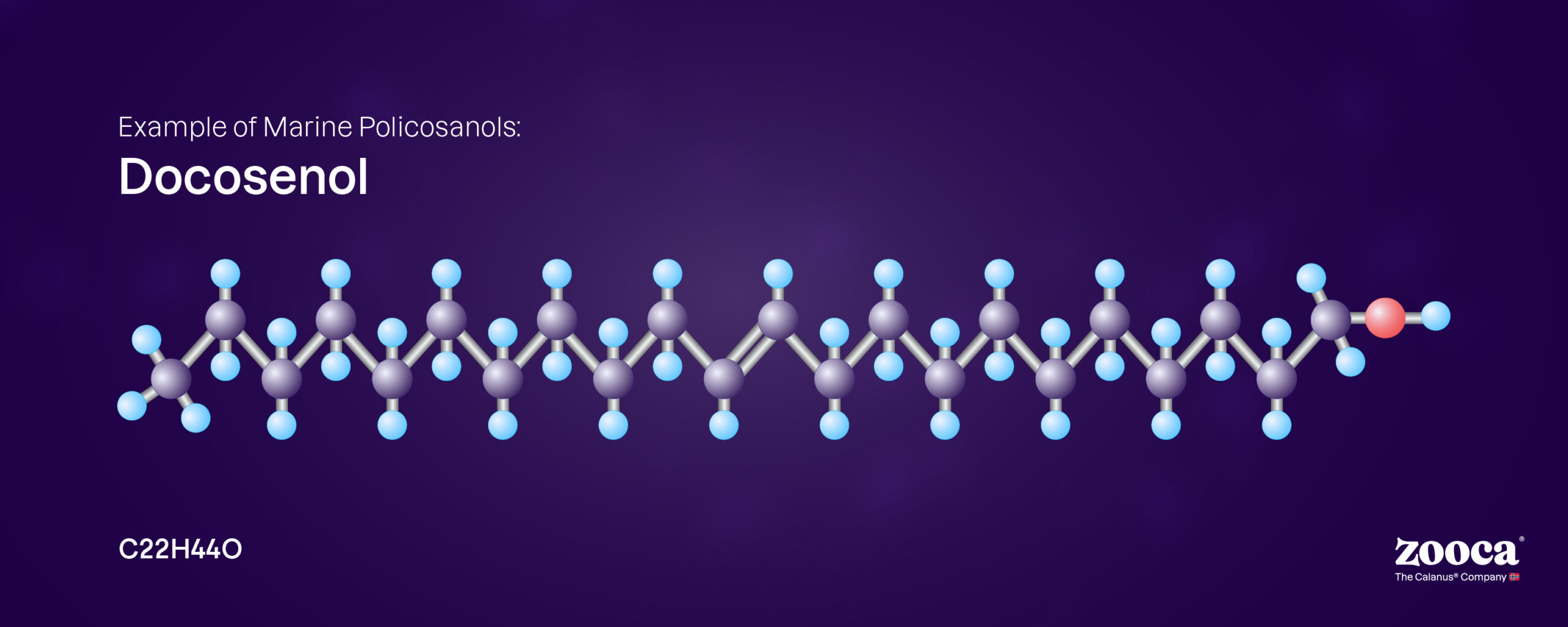
This profile differs from many plant sources, where longer-chain alcohols like octacosanol (C28) dominate.
Are marine policosanols unique to Zooca® Calanus® Oil?
Zooca® Calanus® Oil is the only Omega oil that contains substantial amounts of marine policosanols. This is due to its wax ester structure. By contrast, neither fish oil nor krill oil contain marine policosanols.
How do marine policosanols work in the body?
While structurally different, the marine policosanols present in Zooca® Calanus® Oil may be considered the "cousins" of fatty acids. When consumed, they can be converted into fatty acids by the body and utilized in a similar manner to other fatty acids. While the exact mechanisms of action of policosanols are still being studied, they are recognized for their potential role in supporting cellular and muscular function and broader metabolic processes.
Wax esters are digested differently from triglycerides and are hydrolyzed further along the intestinal tract (Cook et al., 2016). This distinct digestion profile means that both the fatty acid and the long-chain alcohol components are delivered in a coordinated manner.
This structural pairing is unique. In triglyceride-based marine oils, there is no long-chain alcohol partner. In phospholipid-based oils, fatty acids are linked to a different backbone. Marine policosanols are therefore absent from these systems and unique to Zooca® Calanus® Oil.
A composition you won’t find in other marine oils
Most comparisons between marine oils focus exclusively on EPA and DHA content. Zooca® Calanus® Oil is not defined by fatty acids alone. Its intact wax ester structure means it naturally retains:
- Marine policosanols
- A broad-spectrum fatty acid profile
- High levels of naturally occurring astaxanthin
This unique 3-1 composition coexists within one unified lipid system that cannot be recreated by concentrating single fatty acids or blending ingredients.
Beyond single nutrients
Policosanols have been studied in nutrition science for decades, primarily from plant-derived sources. Chemically, these belong to the same class of long-chain alcohols (Sánchez et al., 2019).
What distinguishes Zooca® Calanus® Oil is not simply the presence of this chemical class, but the fact that marine policosanols are naturally present in significant amounts within an intact wax ester system.
- They are part of the molecular structure.
- Part of the lipid system.
- Part of what makes the oil fundamentally different.
Zooca® Calanus® Oil is not defined by a single nutrient. It is defined by its structure, its composition, and the integrity of its natural design.
Designed by nature.
References
Pedersen, A. M., Vang, B., & Olsen, R. L. (2014).
Oil from Calanus finmarchicus—Composition and possible use: A review.
Journal of Aquatic Food Product Technology, 23(6), 633–646.
https://doi.org/10.1080/10498850.2012.741662
Cook, C. M., Larsen, T. S., Derrig, L. D., Kelly, K. M., & Tande, K. S. (2016).
Wax ester–rich oil from the marine crustacean Calanus finmarchicus is a bioavailable source of EPA and DHA for human consumption.
Lipids, 51, 1137–1144.
https://doi.org/10.1007/s11745-016-4189-y
Irmak, S., & Dunford, N. T. (2005).
Policosanol contents and compositions of wheat varieties.
https://doi.org/10.1021/jf050426q
Sánchez, J., et al. (2019).
Policosanols: Chemistry, occurrence, and health effects.
https://doi.org/10.1007/s40495-019-00174-9