

Wax esters – Why lipid structure matters
This article focuses on wax esters, the lipid structure of Zooca® Calanus® Oil, and explains why its unique lipid structure and digestion is a framework for understanding the ingredient, and why we say that Zooca® Calanus® Oil goes beyond omega-3.
When marine oils are compared, the conversation is often around fatty acid composition, although some conversation has been focused on which omega-3 absorbs the quickest. EPA and DHA levels, ratios, and percentages tend to dominate ingredient comparisons, and when it comes to form, the conversation has long been on quick absorption, rather than focusing on fatty acid receptors that are further along in the intestines that most marine oils never reach.
What is discussed around forms is that marine lipids naturally occur in different structural forms, and that lipid structure plays a decisive role in how quickly fats are digested, absorbed, and utilized biologically in the body.
Wax esters digest more slowly—and that changes biological outcomes
In marine biology, lipid structure is closely linked to function. Energy storage, buoyancy, and metabolic regulation depend not only on which fatty acids are present, but also how the lipids are structured and which receptors they interact with in the body.
Wax esters consist of a fatty acid bound to a long-chain fatty alcohol with an ester bond. This structure differs from triglycerides, where three fatty acids are bound to glycerol, and from phospholipids, where fatty acids are bound to a glycerol backbone together with a phosphate-containing head group.
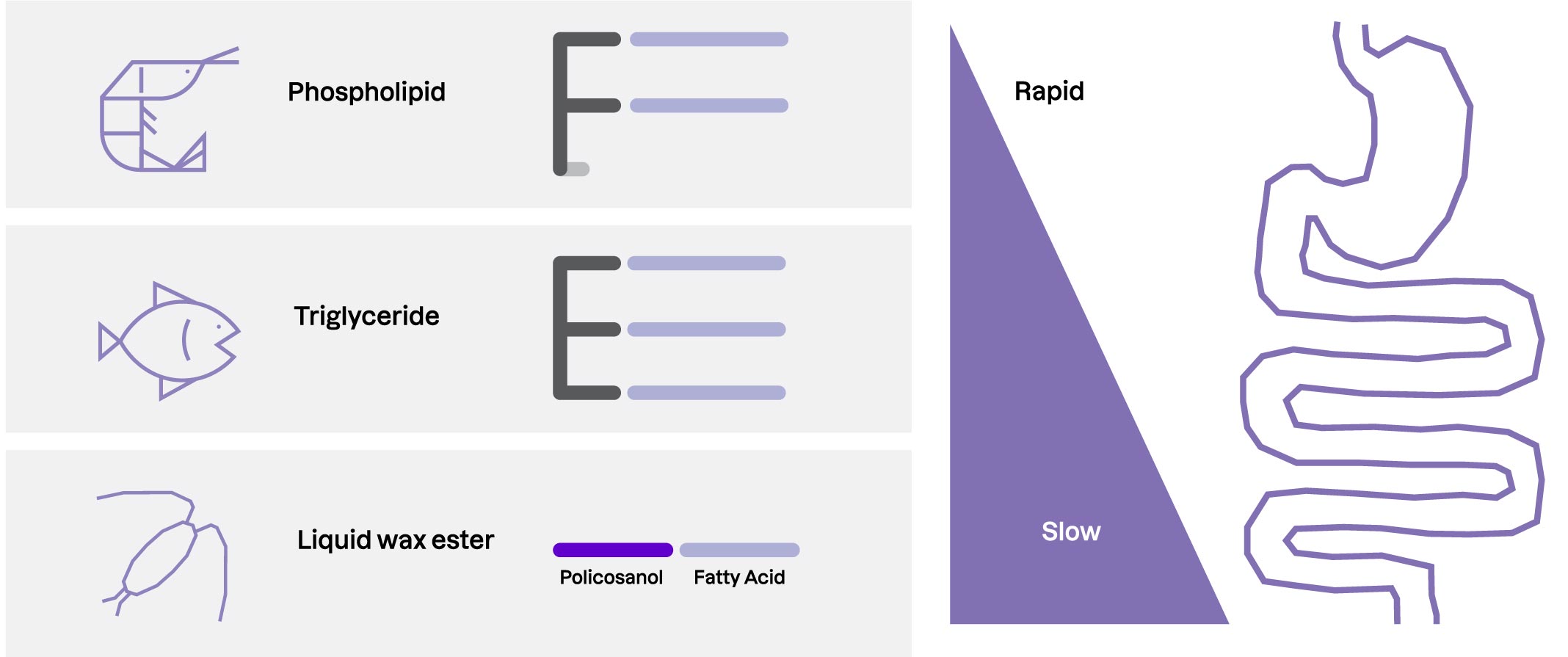
In Calanus finmarchicus, wax esters represent the dominant lipid class and function as an efficient long-term energy store adapted to seasonal variation in food availability. The biological relevance of wax ester–rich marine oils, and their potential physiological implications, have been discussed in both experimental and human studies (Schots et al., 2020).
From marine biology to human digestion
The same structural features that are important in marine organisms also influence how wax esters behave in the human digestive system.
Because wax esters must be broken down into both fatty acids and fatty alcohols prior to absorption, they follow a different pattern of digestion and absorption over time compared to triglycerides, which is the form of fat naturally found in seafood. In vitro studies of marine lipids demonstrate that lipid structure influences digestion behavior and the rate at which fatty acids become available for absorption (Dalheim et al., 2023).
Human data confirm that wax ester–rich Zooca® Calanus® Oil is a bioavailable source of EPA and DHA. In a 12-week randomized study, omega-3 fatty acids from Zooca® Calanus® Oil showed superior bioavailability that is comparable to that of fish oil and krill oil, despite differences in lipid structure (Vosskötter et al., 2023). Detailed investigations of utilization, composition, and digestion further support that differences in absorption profiles reflect digestion and absorption over time rather than reduced uptake (Pedersen, 2016; Cook et al., 2016).
Why slow digestion matters
A slower digestion profile reflects a different exposure pattern over time, rather than a change in overall bioavailability. This influences what receptors in the body will be targeted and ultimately what biological and physiological outcomes happen in the body.
Dietary fatty acids are known to act not only as nutrients but also as signaling molecules involved in metabolic regulation. Lipid structure and digestion over time may therefore influence how and when fatty acids interact with lipid-sensitive pathways, including receptors such as FFA4 (GPR120) (Ulven & Christiansen, 2015).
Additionally, mechanistic studies with structurally complex marine oils demonstrate that lipid form influences interactions with the intestinal environment and inflammatory pathways, supporting the relevance of digestion and absorption over a longer period of time, alongside fatty acid composition.
Together, this digestion profile helps explain why wax ester–based marine oils are important in a metabolic health context.
Structure as the foundation for understanding Zooca® Calanus® Oil
Wax esters are not simply an alternative carrier of omega-3 and other fatty acids, rather they represent a distinct lipid structure, with implications for slower digestion over time and biological outcomes.
By starting with structure, it becomes possible to understand:
- why wax ester–based oils behave differently than other fats during digestion
- why absorption occurs more gradually and why it matters for metabolism
- why other characteristics of the oil are best understood in the context of lipid structure, digestion, and receptor interaction
This structural perspective provides a broader framework for understanding Zooca® Calanus® Oil beyond fatty acid composition and diversity.
References
Schots, P. C., Pedersen, A. M., Eilertsen, K. E., Olsen, R. L., & Larsen, T. S. (2020).
Possible health effects of a wax ester-rich marine oil.
Frontiers in Pharmacology, 11, 961.
https://doi.org/10.3389/fphar.2020.00961
Ulven, T., & Christiansen, E. (2015).
Dietary fatty acids and their potential for controlling metabolic diseases through activation of FFA4/GPR120.
Annual Review of Nutrition, 35, 239–263.
https://doi.org/10.1146/annurev-nutr-071714-034410
Cook, C. M., Larsen, T., Derrig, L. D., Kelly, K. M., & Tande, K. S. (2016).
Wax-ester rich oil from the marine crustacean Calanus finmarchicus is a bioavailable source of EPA and DHA for human consumption.
Journal of the American Oil Chemists’ Society, 93, 1345–1354.
https://doi.org/10.1007/s11745-016-4189-y
Pedersen, A. M. (2016).
Calanus® oil. Utilization, composition and digestion.
PhD thesis, UiT – The Arctic University of Norway.
https://munin.uit.no/handle/10037/9759
Vosskötter, F., Burhop, M., Hahn, A., & Schuchardt, J. P. (2023).
Equal bioavailability of omega-3 PUFA from Calanus oil, fish oil and krill oil: A 12-week randomized parallel study.
Lipids, 58, 231–243.
https://aocs.onlinelibrary.wiley.com/doi/10.1002/lipd.12369